Dunbarton – Englund

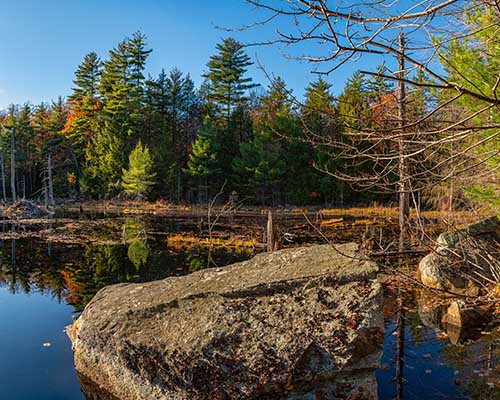
Photo by Drew Groves

Stark Highway South
89 acres of fields, forest, and wetlands
No public access
February 2026

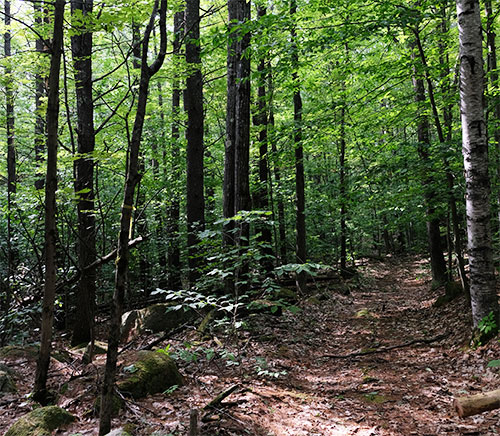
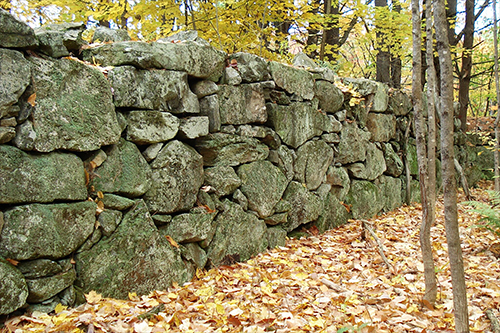
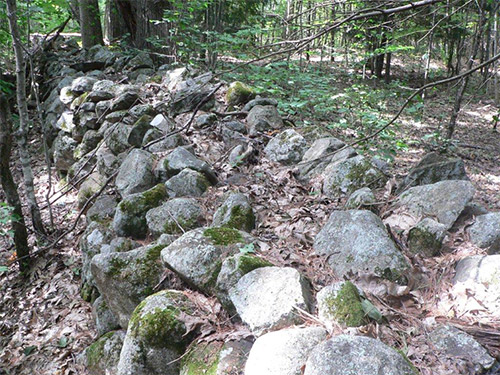
In February 2025, Five Rivers Conservation Trust announced the permanent protection of 89 acres of farm fields, forests, and high-quality wetlands at the Englund Family Farm in Dunbarton. The land and buildings were historically part of Dunbarton’s Twiss Farm, whose owners raised sheep, grew potatoes and hay, harvested timber, and built the stone walls that remain today. Many years later, in 1983, Thomas and Susan Englund purchased the property. Their daughter loved riding her horse on the trails, and their son spent hours exploring the old logging roads and fishing in the beaver ponds. Today, more than 40 years later, both children remain deeply connected to the land.

As their children grew older, Tom and Sue developed a keen interest in conserving the land. Brett St. Clair is a neighbor and Chair of the Dunbarton Conservation Commission, and they were friends with other conservation-minded Dunbarton residents like the Koerbers (Koerber Family Forest, conserved with Five Rivers in 2021) and the Stones (Stone Farm, conserved with Five Rivers in 2017).  When Tom passed away in 2023, Sue drew on these connections and contacted Five Rivers, working closely with Five Rivers’ long-time volunteer project manager, Rob Knight, to begin the conservation process.

The Englund Family Farm is an important addition to an impressive network of conserved lands near Dunbarton’s village center. It is located about a half mile from each of three large clusters of conservation lands, altogether totaling over 18,000 acres extending across Dunbarton and three neighboring towns. The Dunbarton Conservation Commission has been actively protecting open space outside the village over the past several decades. This is Five Rivers’ sixth project in Dunbarton, where the organization now holds conservation easements on 915 acres.

Sue Englund feels fortunate that her children are solidly behind the permanent protection of this land. She comes from a family with a long appreciation of the outdoors and land conservation.  Her grandfather emigrated from Switzerland to the San Francisco Bay Area in 1906 to work rebuilding the city after the devastating earthquake. True to his Swiss origins, he was an enthusiastic outdoorsman and collaborated with others in the Bay Area to establish the Sierra Club. His priorities remain strong with his descendants today.

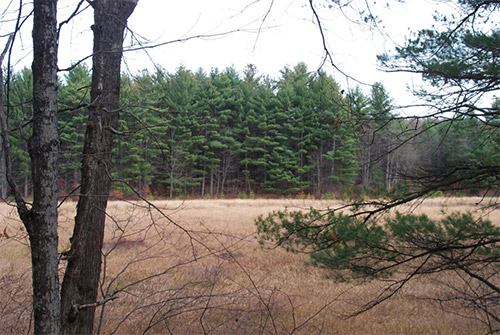
The Englund Family Farm includes a variety of highest-quality habitats. A 5-acre field in the southwest corner of the land is managed for hay and mowed regularly. The conservation area includes most of two large, active beaver ponds, a beautiful but fragile quaking bog, whose floating vegetation flowers in early summer, and two intermittent streams that eventually feed into the marshes north of Dunbarton’s Kimball Pond Tract. Small, forested wetlands occur throughout. Overall, the property’s hayfield, early successional woodland, beaver ponds, and numerous wetlands provide rich habitat that supports diverse wildlife, including bear and moose, turkeys, and wood ducks.

The property also offers excellent opportunities for future recreation and is an important link in the planned greenbelt around the village of Dunbarton. The conservation easement allows for the eventual development of a public trailhead, parking area, and hiking trails. 

In addition to Rob and his thoughtful and persistent efforts on this project, many thanks go to Brett St. Clair and the Dunbarton Conservation Commission. Sue Englund donated the conservation easement, and the Conservation Commission funded up to $34,000 of transaction costs to make the easement project possible. “The Englund property is the old Twiss Farm, one of the older homesites in Dunbarton,” notes Brett St. Clair, Chair of the Conservation Commission. “Conserving it as open space, as with several other Five Rivers and Dunbarton Conservation Commission projects, helps to maintain the rural character of the village center.”  

Brett St. Clair concludes, “We appreciate the Englund family’s love of their land and desire to pass that along in perpetuity.” 
Continue Reading

Dunbarton – Layne

Stark Highway North
134 acres of fields, forest, and wetlands
Public access, no formal trails
August 2024

Five Rivers Conservation Trust is pleased to announce the permanent conservation of the 134-acre Kathryn Layne property near the center of Dunbarton.

Kathryn’s brother, Ken Koerber, is a longtime Dunbarton resident who owns a 131-acre farm in the center of town that he conserved with Five Rivers in 2021. The latest in the family’s generous contributions to land conservation was made by Kathryn, who, on August 1, 2024, donated a conservation easement on her 134 acres to Five Rivers Conservation Trust.

“From a Dunbarton Conservation Commission perspective, it is wonderful that so much of Mrs. Layne’s property has been conserved,” said Brett St. Clair, chair of the Dunbarton Conservation Commission. “Now two large abutting farms, owned by a brother and sister, are permanently conserved and help maintain the rural character of our town.”

The 134 acres that Kathryn Layne conserved contributes to a large block of over 750 mostly contiguous acres protected by Five Rivers in Dunbarton, including the Koerber Family Forest (conserved 2021), Stone Farm (conserved 2017), and the Farley property (conserved 2013).

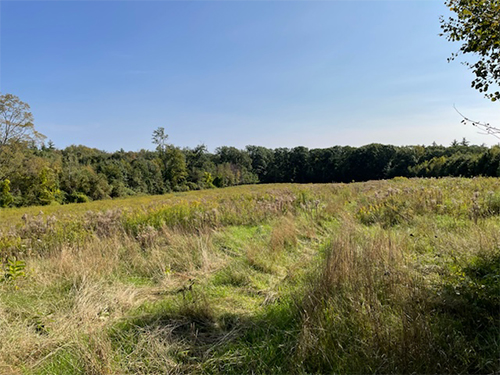
The property is mostly wooded, but three open fields remain, remnants of the Ryder farm in the late 1880s. The land includes uplands, fields, shrublands, forest, young forest, pond, brook, and wetlands. In addition to protecting the land and important wildlife habitat, conservation of the Layne property allows the Dunbarton Conservation Commission to extend walking trails from the Dunbarton Elementary School parking lot and loop through both the Koerber and Layne properties.

The Dunbarton Conservation Commission funded $30,000 of transaction costs, including a survey, to finalize the easement.

Continue Reading

Dunbarton – Koerber

Stark Highway North
131 acres of forest and streams
Public access, no formal trails
November 2021

The Koerber Family Forest contributes to a large block of approximately 650 acres of conserved land nearby, including the Stone Farm and the Farley property, which were conserved by Five Rivers in 2017 and 2013, respectively. In addition to protecting three headwater streams and providing important wildlife habitat, conserving the land creates opportunities for future pedestrian trails and use as an outdoor classroom for the neighboring Dunbarton Elementary School.

“I am thrilled that this land will remain a farm in perpetuity for the public to enjoy, and that wildlife will have a secure home here, thanks to Five Rivers and their many generous donors,” said Ken Koerber. Ken and his wife, Susan, raised their three children on the land, and the couple owns and operates Chanticleer Gardens, dedicated to producing organically-grown cut flowers for local florists and retailers.

“The Koerber’s farm is located right in the center of Dunbarton and preserving it as open space is crucial in maintaining the rural character of our town,” said Brett St. Clair, chair of the Dunbarton Conservation Commission.

Conservation of the Koerber Family Forest is the culmination of a multi-year effort by Five Rivers to raise the necessary funds and finalize the purchase of the conservation easement, after the Koerbers’ initial offer to donate half of the value of the easement. The project was made possible by several critical state and community funding partners, including New Hampshire’s Land & Community Heritage Investment Program (LCHIP), which awarded a $100,000 grant to the project; the Dunbarton Conservation Commission; the Merrimack Conservation Partnership; the New Hampshire State Conservation Commission “Moose Plate” Conservation Grant Program; the New Hampshire Drinking Water and Groundwater Trust Fund Grant; as well as over $19,000 in private donations.

Continue Reading

Dunbarton – Stone Farm

Stone Road
237 acres of farmland, fields, and forest
Public access, no formal trails
January 2017

The rich history of Stone Farm goes back to the 1780’s when the first Stone ancestor farmed this land and is evidenced by spectacular foundations and cellar holes that tell the story of two centuries of life and farming in this corner of Dunbarton. Generations of the Stone Family raised agricultural crops from hops to apples to dairy cows. Today, hay from the farm feeds beef cattle. Logs and firewood are harvested sustainably. Visitors can see relics of buildings from long ago. Wildlife roams freely through the Stone Farm and surrounding conserved lands – now over 600 acres in all.

To learn more about the history of the farm, click here.

The Dunbarton Conservation Commission plans to create a public trail on the property in the near future, exploring some of the remarkable stone foundations and stone walls that speak to the land’s past use.

Geological Center of New England

Stone Farm is also significant because, according to several geographers, it is the geological center of New England. From science.answers.com: “The geological center of New England is located at 43.117199 degrees latitude and -71.593498 degrees longitude, at the intersection of Guinea and Stone roads in Dunbarton. The person to officially answer that question was Suchi Gopal, professor in Boston University’s Department of Geography and Environment. Gopal used the center of gravity, or “centroid,” method. “A mathematical calculation that uses a digital representation of the six New England states is the most accurate because it’s based on a math algorithm that the computer uses to calculate the center based on the boundaries,” Gopal said. Her calculation, she added, also took into account the irregular coastline of Maine and the islands off the coast of Massachusetts.

In fairness, there are other methods for determining the geographic center of New England and other towns also make the claim: Norway, Maine; Wakefield, NH; and Sanford, Maine.

Continue Reading

Dunbarton – Farley

farley-pageGrapevine and Guinea Roads
256 acres of fields, forest, and wetlands
No public access
December 2013

In 2013, Anne Farley donated a conservation easement on 256 acres in Dunbarton to Five Rivers Conservation Trust. Anne, who lived on the property for 36 years, referred to it as the “Lord Farm” in recognition of the family that farmed the land for generations.

Located on Grapevine Road and Guinea Road, the property includes a combination of fields, forests, and a large vegetated wetland associated with Bela Brook, a town conservation priority that originates just beyond the property and flows through it. The conserved land rises 440’ from the wetland to the east boundary, and the change in vegetation reflects this change in topography.

Over the years, Anne raised sheep, goats, chickens, and horses on the property to which she and her husband Earl retired. She carded, spun, dyed and knitted the wool into many fine pieces cherished by those who now wear a piece of our agricultural heritage. Anne Farley passed away in April 2023.

Continue Reading

Dunbarton – Burack

burack-page Black Brook Road at the Goffstown town line


67 acres of forest with extensive wetlands and brook frontage
Public access, no formal trails
May 2000

The Burack-Cathcart easement in Dunbarton has 1,000 feet of road frontage, providing scenic views of an open-water beaver marsh and the abundant wildlife it attracts, including moose, beaver and migrating waterfowl.

The property supports a wide diversity of both wetland and upland habitat. The upland portions are dominated by knolls forested with mature mixed hardwoods, hemlock and mixed softwoods.

In the 1990’s the property was nearly developed as a residential subdivision. Two abutters, assisted by the community were able to purchase the property from the developers. They subsequently established a conservation easement with Five Rivers Conservation Trust to protect wildlife habitat, while allowing recreation and limited forestry.

Continue Reading